|
We are deeply saddened by the death of Judson Albahm amid his mental health crisis. We are proud of Judson for his forethought in seeking help in facing his challenges and disappointed that he could not find the help he needed. Central New York families are sadly familiar with the struggle to access appropriate mental health care. We mourn with Judson’s family and join with them in calling for the marshaling of resources to adequately care for vulnerable members of our community like Judson.
The closures of outpatient mental health facilities in Onondaga County have left families adrift as they seek help for their loved ones and for themselves. The inadequate understanding of the needs of autistic people further leaves people like Judson with limited options for treatment or support during a crisis. We encourage families in crisis to reach out to Upstate University Hospital’s Emergency Psychiatry Service, located at the downtown campus, for care. In service, Sanchia A. Callender, Inc Autism Mental Health Initiative Advisory Council Parents for Public Schools of Syracuse, Inc Neurodiversity Consulting LLC The Academy of Excellence, Inc Joshua Michael King for Students Masking and Kompany
2 Comments
by Liza Citron  Educators can make the best experiences for students in the classroom. Educators can make the best experiences for students in the classroom. As teachers are going back to school, many might have an autistic or otherwise neurodivergent child in their class -- perhaps for the first time. Educators might reasonably wonder where to begin in tailoring the classroom experience to that child -- connecting to the child as an entirely new experience for the teacher. How different is the autistic experience to the neurotypical one? How does autism affect a child in their formative years? What changes should be made for the child to help them connect to the curriculum and the teacher, and to help them succeed? These are all questions teachers might be asking themselves as the “mad rush” to prepare for the school year comes into full swing.
All these questions may seem daunting to the teacher, especially ones new to their classroom. Everything comes down to paying attention to and carefully observing the child -- and, of course, listening to what they may tell you. Careful observation can tell you what the child’s most significant struggles are, and conversely, what their greatest successes or strengths are or maybe in the future. As an autistic adult, I don’t personally know the neurotypical experience. I can, however, compare my autistic experience with descriptions from neurotypical friends and family members. My perspective helps provide insight into neurotypical and neurodivergent experiences that impact the classroom. One of the main differences I have noted is the capacity for sensory input and susceptibility towards over-stimulation. Things neurotypicals might not even notice can be “deafening,” if you will, to an autistic individual -- and can cause either shutdown or meltdown, depending on the situation. As such, the best learning/work environment for many autistic people, and neurotypical people is one with the least sensory stimuli possible. In such a situation, it is easier to maintain concentration, and much easier to lower anxiety levels, both of which provide a more productive mental state. Another difference to consider, especially with young children, is the theory of mind -- seeing situations from another’s perspective. Theory of mind is an aspect of human behavior and neurology that is important in relationship building and learning. Contrary to what some may think autistic people are not insensitive to what others need or want. However, it can often be difficult for us to see those needs and wants in the context of a situation. Providing an environment for role-play, or anything that requires “characters” can often help develop a person’s understanding of the theory of mind. Every individual, autistic or not, will have their levels and specifics of needs, struggles, and strengths. The above are just two of the multitude of ways in which the autistic experience can differ from the neurotypical one. Taking the time to learn, understand, and account for these individual aspects allows educators to set themselves and their students up for success in the new school year. Read more Neurodiversity Rewires Conventional Thinking About Brains *From December 2007. This brilliant advertising campaign was supposed to raise the profile of autism or something. Still not sure why so many learned people thought this was an okay way to present autism and the people who live with autism to the world. This is quite repulsive. In a society that seems to put self esteem above all else for children it seems that it is quite alright to degrade individuals with developmental delays and psychiatric disorders and perpetuate stereotypes about them under the guise of raising awareness. The kids really did spend Christmas playing with the boxes the toys came in. *Originally posted on my personal blog.
I've been busy researching and writing my first book about autism, Parenting Autism. Please considering supporting my book by donating and/or spreading the word. Thanks! So the DSM 5 is finally available to the public. The new diagnostic criteria for Autism Spectrum Disorders presents a bit of problem for researchers but also an opportunity. Previous research using DSM IV criteria will not be comparable to subsequent research using the new DSM 5 criteria. What does this mean for the research community? First, even though the diagnostic criteria in the DSM have changed the diagnostic tools, such as the ADOS and ADI-R, have not. So perhaps the data from studies using the same diagnostic tools can be evaluated using DSM 5 criteria. Second, hopefully previous studies will be replicated using the DSM 5 diagnostic criteria. This should lead to a better understanding of Autism Spectrum Disorders.
First, the illustrations that accompany the text are great. The illustrator, Jonathan Powell, manages to capture the confusion that comes along with the whirlwind of changes youngsters experience while going through puberty. I had a good chuckle over a few of them because I remember feeling that confused when growing up and I’ve seen those looks on people’s faces in real life.
Attwood presents information for parent and child alike in simple but accurate terms allowing for the straightforward communication of information that helps to minimize anxiety generally associated with these aspects of growing up. Parents and youngsters both get a clear idea of what’s going and with this knowledge both are able to prepare for the changes of growing up. This next section alone sold me on the book and prompted me to write this review. Attwood’s insight into how the mind of a youngster works is apparent in her discussion of how and why they have to begin bathing daily. She is very clear, you’ve got to bathe every day and it is not enough to get in the shower and stand there getting wet. You have to use soap. How many times have I had this same conversation with my own children! Attwood explains the process of daily bathing, focusing on specific areas of the body and explaining why those areas need special attention with soap. The fact that she recognizes the need to be this explicit about something as seemingly simple as bathing indicates that Attwood knows her audience well. Finally Attwood addresses issues of sexuality with a neutral tone that allows parents to bring their own values and moral convictions to the conversation without having to work around anyone else’s agenda on the matter. Such sensitivity can be appreciated by a wide range of people making the book a useful tool for pretty much anyone who is looking to prepare themselves and the youngsters in their lives for the rollercoaster ride of puberty into adulthood. A recent New York Times article has stirred up a lot of concern about the coming revisions of the diagnostic criteria listed in the fifth edition of the Diagnostic and Statistical manual (DSM V). Autism specialist Paul Meier shares his comments on the controversy and the upcoming changes in the DSM V. 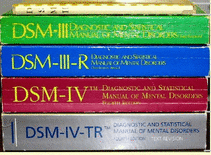 DSM V proposed revisions
I will probably be taking an unpopular position. However, I want to calm some people who are legitimately upset as they are concerned about the well-being of their children, and the children of others, regarding the changes in the DSM-V as they pertain to autism. I do not see anyone getting undiagnosed. I do not see anyone getting services loosing those services. Hopefully I can sufficiently explain this to calm people. There is a critical flaw in the study the NY Times article relied on. They were using 1993 data for the study. In 1993 there was only the DSM-III. Asperger's and PDD-NOS were not even in the DSM. So much more has been learned about autism in the last 19 years using such old data is absurd. 19 years ago they still were not too sure what they were looking for. This would have a huge impact on the data gathered. I am guessing it was all there, but the people recording data didn't know to look for it and therefore could not record it. As someone who is around autism all day every day, and does diagnostic work, I don't think there needs to be fear about the proposed changes to the DSM coming out in 2013. I need to stay on top of all this, and intimately understand all the details and nuances. It is my job. I work with the DSM-IV and I am also familiar with the expected changes in the DSM-V. The proposed changes came out 2 years ago, and were last tweaked a year ago. The only recent change that ignited a firestorm was there was an article in the NY Times January 19, 2012. Autism, Asperger's, and PDD-NOS are all really the same thing. With recognizing that, and understanding it in an everyday clinical sense from professionals, the APA is combining the three into one diagnosis of "Autism Spectrum Disorder". This makes complete and total sense, and I support it 100%. The only question then is does the new diagnostic criteria make sense and work. Part of the problem is that a lot of people do not understand the criteria as they are now, including a lot of professionals. The autism spectrum is not a scale of mild to severe, with the diagnosis you receive depending on the severity of symptoms. Spectrum represents a diversity in individual manifestation of symptoms. By Samantha Pierce
Is Asperger's Overdiagnosed? Recently the above question, posed and supposedly answered in the affirmative in a pair of New York Times opinion editorials, has been making the rounds in public discourse. It is interesting that as awareness of autism spectrum disorders begins to rise the response of the public seems to be that autism spectrum disorders, of which Asperger's is one, are over diagnosed. I would love to see some research to back up such claims. Anecdotes do not equal data as the saying goes. I think this represents a spilling over of a long standing conflict within the autism community. If you spend enough time in any autism related forum you will eventually find two different camps of opinion. There are those who divide the autistic community into the "real" autistics, those who are easily identified as having some sort of impairment (often non-verbal), and the "fake" autistics, those who are able to communicate with the neurotypical world (i.e. they can talk or at least write like they can talk). Then there are those who recognize that the "real" and "fake" autistics fall under the same umbrella if one is willing to take a careful look at how they experience the world. Personally I have children who fall into both of these categories and I see this conflict as a harmful distraction for the autistic community. As different as my children may appear to be to the outside world, upon close examination they have many traits in common. Now that the unsubstantiated claims that there are "real" and "fake" autistic people have hit the mainstream we are beginning to see why this conflict is so harmful in the first place. These unsubstantiated claims of over diagnosis are now being used to marginalize people that many have been fighting to bring into the mainstream. Research into the matter indicates that autism spectrum disorders are likely under diagnosed. Anyone claiming otherwise needs to bring data to the table for rigorous evaluation. |
Categories
All
Archives
December 2021
|
 RSS Feed
|
|